VEET Schedule 34 Discount Factors - Consultation Paper & Government Gazette
Newsletter archive
This newsletter has been retained as a dated collection of updates, with links to current Northmore Gordon guidance.
Publication date: September 27, 2017.
Status note: Deadlines, prices, program settings and event information below belong to the issue date. Use current official sources for present decisions.
What this article reported
As required by the VEET Act they have also released the Government Gazette "Notice of Intention to Declare a Discount Factor" and hence have put everything in place to introduce a discount factor for both Highbays and T8/T12 Fluorescent Lights from the 1st of January.
As suggested by EECCA they are proposing to implement the discount factor in two stages to give businesses time to adjust. Initial change on the 1st of January 2018 and a further change on 1st of April 2018.
- Metal Halide, Mercury Vapour, and High-Pressure Sodium (eg highbays, floodlights, certain rectangular shop lights and some others)
- DF: 0.85 from 1st January 2018 to 31-Mar-2018
- DF: 0.7 from 1st April 2018
- Fluorescent T8/T12 (retail, offices, warehouses, factories, schools, etc)
- DF: 0.9 from 1st January 2018
- DF: 0.8 from 1st April 2018
Given that the government released the issues paper on the 18th of August and has included some of the recommendations from submissions to the previous issues paper, it appears highly likely that once the consultation process has been completed that the government will go ahead with this change.
The discount factor is a multiplier (default value of 1.00) for the carbon dioxide equivalent emissions and hence the proposed multipliers will reduce the VEEC quantity for upgrades from the lamp types above. EG A typical MH highbay to LED receiving 17 VEECs will receive 0.7 x 17 = 11.9 VEECs from the 1st of April.
It isn't clear from the consultation or gazette if the dates apply to the Activity Date (ie jobs completed by the dates above) or Creation Date (jobs submitted to the VEET portal by the dates above). In the past, the types of changes have applied to the Activity Date. We are seeking further clarity and will let you know once we hear back from DELWP.
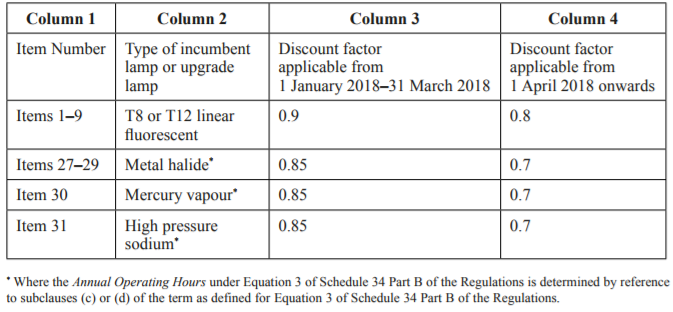
Please don't hesitate to contact Wattly for more information. Below is the table from the Government Gazette and links to the consultation paper and Gazette.
https://www.energy.vic.gov.au/energy-efficiency/victorian-energy-upgrades
| Item number | Incumbent or upgrade lamp | 1 January–31 March 2018 | From 1 April 2018 |
|---|---|---|---|
| Items 1–9 | T8 or T12 linear fluorescent | 0.9 | 0.8 |
| Items 27–29 | Metal halide* | 0.85 | 0.7 |
| Item 30 | Mercury vapour* | 0.85 | 0.7 |
| Item 31 | High pressure sodium* | 0.85 | 0.7 |
* The asterisk applies where Annual Operating Hours under Equation 3 of Schedule 34 Part B of the Regulations is determined by reference to subclauses (c) or (d) of the term as defined for that equation. This is a historical extract; check current regulations before relying on it.
*Note that this does not apply to Non-Building Based Lighting under Schedule 34
How to use this information now
Treat each item as a historical snapshot. Confirm the current reporting period, program status, market date and official guidance before applying it to a project or compliance decision.
Separate source-reported facts from forecasts, targets and commentary. For a current project, retain the official source, version, effective date, assumptions and decision record in the evidence file.
Related guidance
What is the VEET Schedule 34 discount factor, and why is the Victorian Government introducing it?
The discount factor is a multiplier applied to Victorian Energy Efficiency Certificate (VEEC) quantities for specified lighting upgrades. The government is introducing it to address market transformation concerns—as lamp technologies become standard practice, the carbon abatement value per upgrade diminishes. The proposed discount factors of 0.85 (reducing to 0.7) for Metal Halide/Mercury Vapour/High-Pressure Sodium and 0.9 (reducing to 0.8) for Fluorescent T8/T12 reflect this reduced additionality. The staged implementation gives businesses time to adjust procurement and project planning.
Which lighting technologies and applications are affected by the proposed Schedule 34 discount factors?
Metal Halide, Mercury Vapour, and High-Pressure Sodium lighting (used in highbays, floodlights, and certain rectangular shop lights) and Fluorescent T8/T12 lighting in retail, offices, warehouses, factories, and schools are affected. The discount factors apply to upgrades from these baseline technologies, typically to LED alternatives. Non-Building Based Lighting under Schedule 34 is excluded from the proposed changes, preserving VEEC values for that activity category.
What are the proposed discount factor values and staged implementation dates?
For Metal Halide, Mercury Vapour, and High-Pressure Sodium: 0.85 from 1 January 2018, reducing to 0.7 from 1 April 2018. For Fluorescent T8/T12: 0.9 from 1 January 2018, reducing to 0.8 from 1 April 2018. This two-stage approach, incorporated from EECCA recommendations, allows businesses to adjust project pipelines and financial forecasts. A typical MH highbay to LED upgrade would receive approximately 11.9 VEECs (0.7 × 17) from 1 April 2018, down from the original 17 VEECs.
How does the discount factor affect VEEC revenue in lighting upgrade investment cases?
The discount factor directly reduces VEEC quantity per eligible activity, lowering certificate revenue in project financial models. Businesses relying on VEEC proceeds to support project economics must recalculate payback periods, internal rates of return, and funding gaps using the new multipliers. For investment-case development, the timing ambiguity—whether dates apply to Activity Date (completion) or Creation Date (submission)—creates planning uncertainty. We can assist by recalibrating investment cases, advising on timing strategies, and clarifying eligibility assumptions with current DELWP guidance.
Is there clarity on whether the discount factor dates apply to Activity Date or Creation Date?
The consultation paper does not explicitly clarify whether 1 January and 1 April 2018 dates apply to the Activity Date (when work is completed) or Creation Date (when jobs are submitted to the VEET portal). Historical precedent suggests Activity Date is typical, but this ambiguity affects project scheduling and VEEC revenue timing. Businesses with projects straddling the transition dates face uncertainty about which discount factor applies. We were seeking further clarity from DELWP at publication and can provide guidance once DELWP publishes the final Schedule 34 and any accompanying clarification.
What should organisations do now to prepare for the discount factor changes?
Organisations should review lighting upgrade pipelines to identify projects affected by Metal Halide, Mercury Vapour, High-Pressure Sodium, and Fluorescent T8/T12 baselines. Recalculate investment cases using the proposed discount factors to understand impact on payback and funding requirements. Monitor DELWP's final Schedule 34 release and clarification on Activity versus Creation Date application. Consider timing strategies—advancing projects before April 2018 if Activity Date applies or before January 2018 if Creation Date applies. We can conduct impact analysis, recalibrate business cases, and advise on optimal project sequencing given the staged changes.
How should Northmore Gordon clients incorporate discount factor uncertainty into project planning?
Investment cases should present scenarios using current VEEC values and proposed discount factors separately, showing how reduced certificate revenue affects project economics. Identify a decision point tied to DELWP's final Schedule 34 publication and date-application clarification. For projects with flexible timelines, develop acceleration or deferral strategies depending on whether Activity or Creation Date applies. Measure and verification planning should remain independent of certificate assumptions; projects retain operational merit regardless of VEEC proceeds. Our funding-pathway assessment and investment-case guidance can integrate discount-factor scenarios into robust decision frameworks.
What does the government's incorporation of previous consultation feedback suggest about the discount factor's likelihood of proceeding?
The government released an VEET Schedule 34 issues paper on 18 August, and the current consultation paper incorporated recommendations from submissions to that previous paper. This iterative refinement indicates the government is advancing the change through its formal process. The combination of earlier consultation, adjustment of proposals, and release of a formal consultation paper with Government Gazette notice suggests high probability the discount factors will proceed once this consultation closes. Businesses should treat the proposed changes as likely and prepare accordingly rather than await a final decision.
Images on This Page
-
https://px.ads.linkedin.com/collect/?pid=3718913&fmt=gif
(no alt text)
-
https://northmoregordon.com/wp-content/uploads/2020/05/ng-logo.svg
(no alt text)
-
https://secure.gravatar.com/avatar/ab047677377528d869c6355437d1cc98219cfbe4094f611943be2f75fe112a4e?s=96&d=mm&r=g
Picture of Northmore Gordon
-
https://northmoregordon.com/wp-content/uploads/2017/09/VEET-Schedule-34-Discount-Factors-Consultation-Paper-Government-Gazette-1024x683.jpg
VEET Schedule 34 Discount Factors - Consultation Paper & Government Gazette - Northmore Gordon
-
https://ci6.googleusercontent.com/proxy/rEQXfIH2AA7Mx3KlkHdkuen3RPAVzfp780CpGmbsIZPwHvJGEjZektBYrCQxatvbg09y33Ph1ivVysj7XSMsPXrOMisjUfP-d1Xpncr0Css7diGL=s0-d-e1-ft#http://i3.cmail19.com/ei/d/79/C21/41A/103418/csfinal/image.png
(no alt text)
-
https://northmoregordon.com/wp-content/uploads/2025/11/Markets-update-news-WEB-300x139.jpg
(no alt text)
-
https://northmoregordon.com/wp-content/uploads/2026/08/Time-stamped-RECs-300x139.jpg
(no alt text)
-
https://northmoregordon.com/wp-content/uploads/2026/08/Solar-Irrigation-300x139.jpg
(no alt text)
-
https://northmoregordon.com/wp-content/uploads/2026/09/shutterstock_2761180357.jpg
ASRS Group 3: Are you in scope and don't know it - ASRS Reporting Standards - Northmore Gordon
-
https://northmoregordon.com/wp-content/uploads/2025/11/Compliance-Update-–-November-2025-1024x474.jpg
(no alt text)
-
https://northmoregordon.com/wp-content/uploads/2025/08/Renewable-Heat-banner.jpg
(no alt text)
-
https://northmoregordon.com/wp-content/uploads/2025/10/Earn-more-from-CI-solar-WEB.jpg
(no alt text)
-
https://northmoregordon.com/wp-content/uploads/2020/05/ng-logo.png
(no alt text)