
5 Reasons to set a carbon target now

Published: May 18, 2021.

5 reasons to set a carbon target - Northmore Gordon

According to our article, the 5 reasons to set a carbon target now are: (1) Resilience against future regulation, since all Australian states have net-zero by 2050 targets and Victoria has announced an interim target of 50% reduction by 2030; (2) Future-proofing your organisation by incorporating carbon costs into all investment decisions; (3) Driving innovation, as a carbon target incentivises finding better ways to operate; (4) Saving money, since rising environmental charges are passed through to businesses via electricity retailers; and (5) Gaining investor and customer confidence, as investors and customers are already asking what companies are doing to reduce their carbon footprint.

  1. Resilience against future regulation - all states have net-zero by 2050 targets and Victoria just announced the interim target of 50% reduction by 2030
  2. Future-proof your organisation - carbon costs should be incorporated into all investment decisions
  3. Drive innovation - with a carbon target your organisation can be incentivised to find better ways to operate
  4. Save money - environmental charges are on the rise and this cost is passed through to you via your electricity retailer
  5. Gain investor/customer confidence - investors and customers are already asking questions about what companies are doing to reduce their carbon footprint. Can you afford to lose them?

It is clear that there will be a competitive advantage for those who are prepared for the transition to the low carbon economy.

Not sure where to start? We can facilitate a complimentary carbon health check for your management team to understand where your business needs some extra focus. Give us a call and we can arrange a time for this to be done either virtually or in person. To discuss a carbon health check, contact our team.

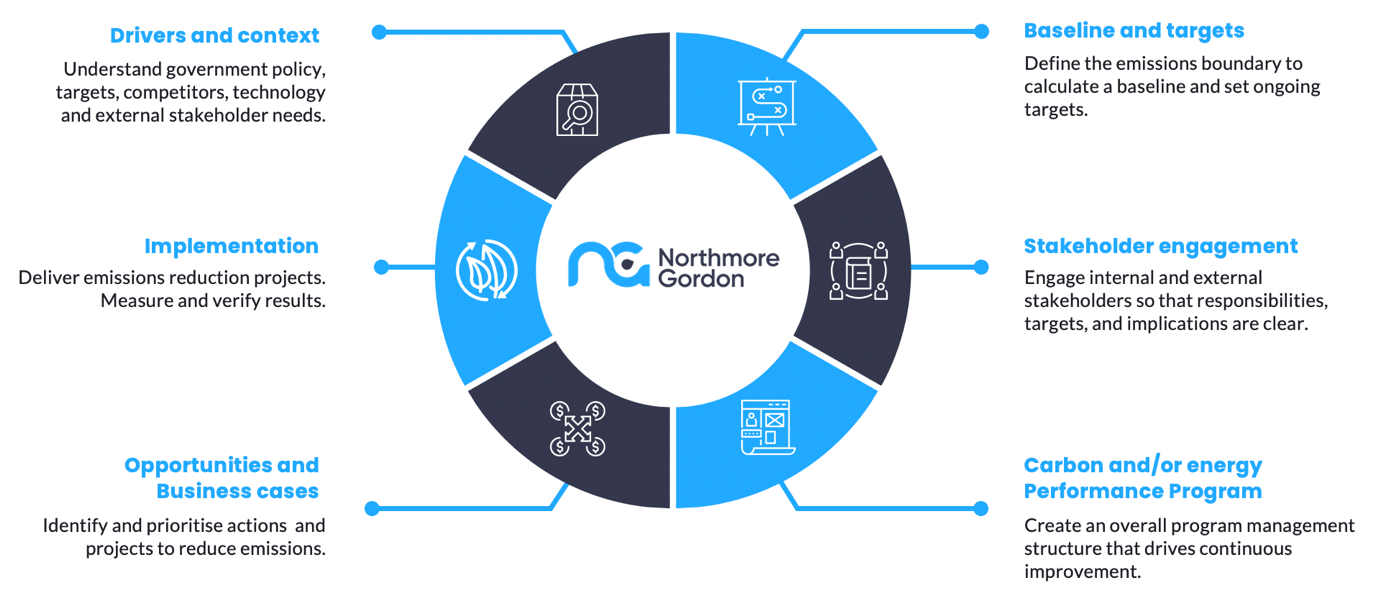
The setting of targets is just one element of a complete carbon strategy as can be seen in the infographic below.
Diagram

Description automatically generated

If you aren't sure where to start on your carbon strategy journey, or you have begun in a piecemeal fashion, we can run a complimentary carbon strategy benchmarking session with your management team to highlight areas where there are gaps, and develop a measured plan to filling them.

Contact our carbon team today carbon@northmoregordon.com

Procurement context

Check the current market date, contract term, meter and load data, instrument ownership and retirement evidence before making a purchasing or public claim.

What are the 5 reasons Northmore Gordon gives for setting a carbon target now?

According to our article, the 5 reasons to set a carbon target now are: (1) Resilience against future regulation, since all Australian states have net-zero by 2050 targets and Victoria has announced an interim target of 50% reduction by 2030; (2) Future-proofing your organisation by incorporating carbon costs into all investment decisions; (3) Driving innovation, as a carbon target incentivises finding better ways to operate; (4) Saving money, since rising environmental charges are passed through to businesses via electricity retailers; and (5) Gaining investor and customer confidence, as investors and customers are already asking what companies are doing to reduce their carbon footprint.

Why does Northmore Gordon emphasize that carbon targets help future-proof investment decisions?

We stress that incorporating carbon costs into all investment decisions now prepares organisations for a transition to a low-carbon economy. By treating carbon as a material cost factor today, businesses can evaluate capital expenditure more realistically and avoid stranded assets or expensive retrofits later. This forward-looking approach also helps identify which operating changes, renewable energy options, and efficiency investments will remain economically sensible as environmental charges and regulatory requirements evolve.

How can setting a carbon target drive innovation within an organisation?

According to Northmore Gordon, a carbon target creates an incentive structure that encourages teams to find better ways to operate. Rather than treating emissions reduction as a compliance burden, a clear target motivates the organisation to investigate alternative technologies, process improvements, energy management practices, and renewable energy options. This innovation mindset can uncover co-benefits such as reduced operating costs, improved product quality, or enhanced staff engagement alongside emissions reductions.

What role do investors and customers play in motivating carbon targets, according to the article?

We note that investors and customers are already asking organisations about their carbon-reduction efforts. The article poses a strategic question: can a business afford to lose those investors or customers by not addressing carbon management? This reflects growing market expectations for environmental accountability. Setting a clear carbon target demonstrates commitment to stakeholders, reduces the risk of losing investment or market share, and positions the organisation as a responsible market participant.

How does Northmore Gordon help businesses that are uncertain where to start with carbon strategy?

We offer two complementary diagnostic services: a complimentary carbon health check conducted virtually or in person with the management team to identify focus areas, and an online carbon health check tool for self-assessment. For businesses that have started carbon work piecemeal or lack a cohesive strategy, we also provide a carbon strategy benchmarking session. These diagnostic services highlight gaps and support development of a measured plan to address them, connecting emissions data with engineering, procurement, and investment decisions.

What is the difference between setting a carbon target and building a complete carbon strategy?

We emphasise that setting a target is only one element of a complete carbon strategy. A full strategy requires transition planning that defines the options available, key assumptions, implementation dependencies, ownership structures, and financial implications of decarbonisation pathways. This comprehensive approach ensures that targets are achievable, that responsibilities are clear, and that the organisation can track progress and adapt as conditions change. Our carbon advisory services connect emissions inventories with this actionable planning.

What competitive advantage does Northmore Gordon associate with early carbon strategy preparation?

We emphasise that there will be a competitive advantage for organisations that prepare early for the transition to a low-carbon economy. Businesses that establish carbon targets and strategies now can position themselves to capture emerging market opportunities, avoid costly emergency compliance measures, attract investment and talent focused on sustainability, and develop operational efficiencies before competitive pressures force action. Early movers also build capability and learn from experience before regulatory or market shifts accelerate change.

How does rising environmental cost through electricity bills connect to the financial case for carbon targets?

We explain that environmental charges are increasing and these costs flow through to businesses via their electricity retailer bills. By setting a carbon target and managing emissions proactively, organisations can reduce these charges alongside their operational energy costs. This creates a direct financial incentive: transition planning that identifies energy savings, renewable energy procurement through services like moREnewable100, or efficiency improvements pays for itself through lower environmental levies and electricity bills, making the business case for carbon action more compelling.

Why should organisations incorporate carbon costs into investment decisions now, before regulation changes?

Our rationale is that regulations and carbon costs are evolving across Australian states, with net-zero by 2050 targets and interim goals like Victoria's 50% reduction by 2030. Organisations that wait for clarity on future rules risk making investments that assume low or zero carbon costs, then face costly retrofits or decommissioning. By incorporating realistic forward-looking carbon costs into capital expenditure decisions today, businesses avoid lock-in to high-carbon assets, improve long-term financial resilience, and ensure that investment portfolios align with the transition pathway the market and regulators are signalling.

Images on This Page